
What Is an ITEL Report? Ohio Roof and Siding Claim Guide
Published Jun 23, 2026 • Keathley Claims Consultants
Reviewed and updated Aug 4, 2026
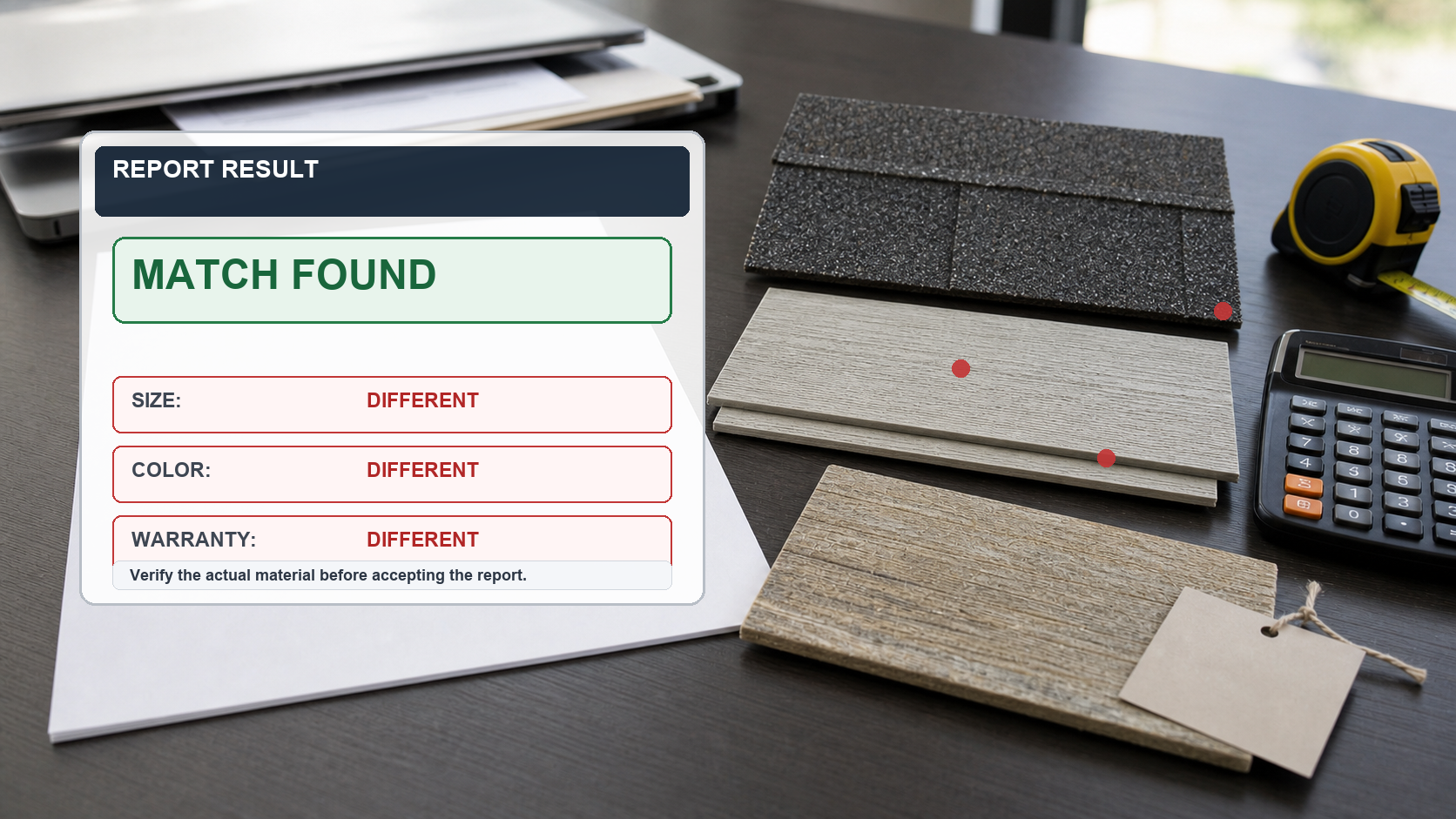
Quick answer: An ITEL report identifies or compares property materials such as roofing, siding, and flooring. It may provide product, pricing, availability, matching, or repairability information, but it does not by itself decide insurance coverage or prove that a proposed repair will reasonably restore the property. When an ITEL result is being used to support a partial repair or reduced estimate, compare it with the policy, physical damage, contractor scope, material availability, warranty, and real repair conditions.
If the report supports a repair-only roof or siding position, see KCC’s roof and siding claim review guidance and learn when a covered amount-of-loss dispute may fit Ohio insurance appraisal.
When an insurance company uses an ITEL report in a property claim, it usually sounds neutral.
“ITEL says this is the price.”
“ITEL says the material matches.”
“ITEL says the roof is repairable.”
That framing matters. It makes the decision feel like it came from an independent third party instead of the insurance company. The carrier can point at the report, the homeowner is expected to accept it, and the dispute shifts away from the carrier’s own judgment.
That is exactly why homeowners should slow down.
ITEL reports may contain useful information. But the deeper question is not whether ITEL has a database, a lab, or a technical process. The question is whether the report is being used as evidence or as a shield.
If the report becomes a way for the insurance company to reduce the estimate, avoid replacement, control pricing, or push responsibility onto an outside vendor, the homeowner needs to understand who ITEL serves, who owns it, how it fits into carrier claim workflows, and what the report actually proves.
Follow the Money: Who Owns ITEL?
ITEL did not grow into a major claim tool by accident. It has been treated as an insurance technology platform by private equity investors.
In 2021, GTCR acquired Global Claims Services, the company behind brands including ITEL. The acquisition announcement described Global Claims Services as an insurance technology company providing “critical cost containment solutions” to the property and casualty insurance industry.
That phrase is important.
Cost containment is not homeowner advocacy. Cost containment is the business of controlling claim cost.
The same 2021 announcement said the company provided insurance carriers with independent assessments of replacement value and repair feasibility, served all of the top 100 carriers in the United States, and gave insurance companies decision-support tools for property claims.
Then, in 2025, GTCR announced that it was selling ITEL Laboratories to Nearmap. GTCR described itel as a provider of data and analytics to the property and casualty insurance industry, supporting more than two million insurance claims annually and serving all of the top 100 insurance carriers in North America.
Nearmap is not just some random buyer. Nearmap is backed by Thoma Bravo, one of the largest software-focused private equity firms in the world. Thoma Bravo acquired Nearmap in 2022 through a transaction valued at about AUD $1.055 billion. Nearmap later announced the itel acquisition and said Thoma Bravo would be the lead strategic investor in the combined company.
So the ownership chain is not hard to understand:
- ITEL was part of Global Claims Services.
- GTCR bought Global Claims Services in 2021.
- GTCR positioned the platform around insurance technology, claim decision support, and cost containment.
- GTCR sold ITEL Laboratories to Nearmap in 2025.
- Nearmap is a Thoma Bravo-backed property intelligence company.
- The combined Nearmap/itel platform is marketed across insurance underwriting and claims.
That does not automatically make every ITEL report wrong.
But it does make the “independent third party” label more complicated than the way homeowners usually hear it.
Independent From What?
Nearmap says it operates as a neutral third party and does not have a financial stake in the outcome of an individual claim.
That may be true in a narrow sense. ITEL may not get a bigger fee because one specific homeowner gets paid less on one specific claim.
But that is not the only independence question.
The better question is:
Is ITEL independent from the carrier claims ecosystem that pays for, deploys, integrates, and benefits from its reports?
That answer is much less clean.
Nearmap’s own product pages are written heavily for insurance carriers and claims programs. They talk about adjusters getting answers in minutes, carrier visibility, integrations into estimating platforms, claim workflow consistency, repairability determinations, preventing full replacements, improving loss ratio, and managing indemnity.
Those are carrier-side concerns.
A homeowner cares about one question: what does the policy owe to properly repair or replace the damaged property?
A carrier claims program cares about a different set of questions: how do we make claim decisions faster, more consistent, easier to defend, and less expensive across thousands or millions of claims?
That is where the conflict lives. ITEL may be presented as a neutral third-party tool, but homeowners should understand the ways the process can lean carrier-side: questionable material matches, mobile app submissions that need independent verification, pricing outputs that may undercut real-world repair costs, and reports used to support repair-only decisions even when the actual property conditions do not support the repair.
Why Insurance Companies Use ITEL Pricing
Insurance companies use ITEL pricing because it gives them a number they can point to.
Nearmap says ITEL’s benchmark pricing integrates directly into Xactimate and Cotality. Adjusters can get an ITEL-backed price embedded in the estimate without disrupting their existing workflow.
That is powerful.
The carrier is not just getting a PDF after the fact. The pricing can become part of the estimating process itself. Once the ITEL-backed number is inside the estimate, the carrier can frame it as objective, data-backed, and defensible.
That helps the carrier in several ways:
- It gives the adjuster a fast price without chasing local suppliers.
- It standardizes pricing across adjusters and vendors.
- It creates documentation for the claim file.
- It gives the carrier a third-party-sounding explanation for a lower number.
- It can reduce arguments inside the carrier’s own workflow.
- It can make the homeowner or contractor look like the one disputing “data.”
But a pricing benchmark is not the same thing as the full cost to perform the repair.
Real property repairs include more than material cost. A real estimate may need labor, tear-off, waste, accessories, delivery, minimum order quantities, taxes, overhead and profit, permit issues, detach and reset work, code items, steep charges, access issues, warranty concerns, discontinued material problems, and matching concerns.
That is why ITEL pricing should be checked against local supplier pricing, contractor scope, real labor conditions, and the full repair method. A material-only number that looks clean inside a carrier estimate can still understate what it actually costs to restore the property.
If a carrier uses ITEL pricing to reduce an estimate, the homeowner should ask whether the report prices the whole repair or only one ingredient in the repair.
That distinction can change the claim value by thousands of dollars.
Why ITEL Helps Shift Responsibility Away From the Carrier
This is the part homeowners feel but often cannot explain.
When the carrier says “our adjuster priced the material at $X,” the homeowner can challenge the carrier.
When the carrier says “ITEL priced the material at $X,” the argument changes.
Now the homeowner is fighting a report. The contractor is fighting a database. The carrier gets to stand behind a vendor and say it relied on an independent source.
That is useful for the insurance company because it moves the dispute away from:
- The carrier’s estimate
- The carrier’s judgment
- The carrier’s claim handling
- The carrier’s choice to repair instead of replace
- The carrier’s decision to pay a lower amount
And it moves the dispute toward:
- The submitted sample
- The ITEL match
- The ITEL price
- The ITEL repairability conclusion
- The idea that the carrier is merely following objective data
That does not eliminate the carrier’s responsibility. The insurance company still owes a proper investigation. The insurance company still owes a claim decision under the policy. The insurance company still has to explain why its estimate is adequate.
But in practice, the ITEL report gives the carrier cover.
The Carrier Workflow Problem
Nearmap’s ITEL NOW page says carriers maintain full visibility across every submission, every party, and every claim in the program. It also says adjusters, contractors, and third parties can submit through the platform, with the carrier maintaining visibility at the center.
That matters.
If the carrier controls the claim program, manages access, sees every submission, receives results into its system of record, and uses the output inside its estimating workflow, then homeowners should be careful about calling the report truly independent in the everyday sense of the word.
It may be independent from the adjuster who visited the home.
It may be independent from the contractor.
It may be independent from a direct commission on one claim outcome.
But it is still operating inside a carrier-managed claim ecosystem.
That is not the same thing as a neutral umpire standing between equal parties.
Repairability: Where the Stakes Get Bigger
ITEL repairability reports can be especially important in roof claims.
Nearmap’s roof repairability page says the product gives adjusters a fast, independent, guaranteed determination. It also discusses reducing unnecessary full replacements and says a carrier’s loss ratio reflects those repairability decisions.
That is the carrier incentive in plain language.
If more roofs are classified as repairable, fewer roofs are replaced. If fewer roofs are replaced, claim costs can go down. If claim costs go down across a carrier’s book of business, the carrier’s numbers improve.
Again, that does not mean every repairability report is wrong.
Some roofs can be repaired.
But the homeowner should not let the word “repairable” end the discussion.
A roof repairability opinion has to be tested against real conditions:
- Can the shingles be lifted without breaking?
- Is the product discontinued?
- Can the repair be matched?
- Is the damage isolated or spread across slopes?
- Will a contractor warranty the repair?
- Are code items involved?
- Are there manufacturer requirements?
- Are brittle shingles being ignored?
- Is the repair provider actually available?
- Does the guaranteed price include everything needed for the real job?
If the answer does not hold up on the roof, the report should not control the claim.
Material Matching: A Database Match Is Not Always a Real Match
ITEL material matching can identify exact or close matches for roofing, siding, and flooring. That sounds helpful, and sometimes it is.
But matching disputes are not just laboratory disputes. They are property disputes.
A siding panel may be similar on paper and still look wrong on the elevation. A shingle may be close in specifications and still create a patchwork repair after years of weathering. Flooring may match a product line but not the actual appearance of the installed floor.
The details matter. A proposed match may fail because the size is different, the color has weathered differently, the exposure is not the same, the profile does not line up, the manufacturer warranty is not equivalent, or the replacement product is not actually available in the amount needed. A match that works in a database or mobile app result does not automatically work on the home.
Nearmap’s material matching page says that when a match is found in discontinued stock, a damaged section can stay a damaged section instead of becoming a trigger for full replacement.
That sentence explains why carriers care.
If a report can turn a replacement claim into a smaller repair claim, the report has financial consequences.
Discontinued Materials, DMI, and the Condition Problem
This is where Discontinued Materials, Inc. matters.
DMI is commonly shorthand for Discontinued Materials, Inc., and ITEL has publicly tied its discontinued shingle location service to DMI. In an older ITEL video, ITEL said it partnered with Discontinued Materials, Inc. to locate and provide discontinued shingle styles for roof repairs when current products were not available.
Nearmap’s current discontinued materials page now routes that concept through the Nearmap/itel ecosystem, with the promise to help find discontinued asphalt shingles for repair. Nearmap has also said itel maintains a substantial inventory of discontinued shingles, that insurance carriers can benefit from automatic reservations when a match is identified during shingle matching tests, and that products can be delivered directly to job sites as a cost-effective way to avoid full roof replacement in minor-damage cases.
That may sound efficient from a carrier claim-cost standpoint.
But from the homeowner’s side, it raises a serious question: what exactly is the carrier asking the homeowner to install on the roof?
If a roof product is discontinued, the homeowner should not accept “DMI has it” as the end of the matching dispute. The next questions are whether the material is new-old-stock or previously handled material, whether it is in original manufacturer packaging, whether the manufacturer warranty still applies, whether the shingles have been stored properly, whether the color and weathering actually match the roof, and whether any contractor will install and warranty the repair.
A discontinued shingle sitting in inventory may solve a carrier’s estimate problem. It does not automatically solve the homeowner’s restoration problem.
If the practical answer is “source a small quantity of discontinued material so the carrier can avoid replacing a larger roof area,” the homeowner should push back until the condition, packaging, warranty, storage history, and installability are clear. Like kind and quality is not just a label. Matching is not just a database result. And a repair should not be forced around questionable material simply because a smaller repair scope is cheaper than a broader replacement scope.
For storm-related roof and siding disputes, this is one reason a wind and hail damage insurance claim should be reviewed against the actual property conditions, not just a matching report.
Homeowners should ask:
- What exact material was tested?
- Who took the sample?
- Was the sample representative of the damaged area?
- Is the product actually available in the needed quantity?
- If the product is coming from DMI or another discontinued-material source, is it new-old-stock or used/loose material?
- Is it in original manufacturer packaging?
- Does the manufacturer warranty still apply?
- Who will install it, and who will warranty the repair?
- Does the product match the property in real light and real conditions?
- Does the policy require like kind and quality, reasonable uniform appearance, or something else?
- Is the carrier using the report to avoid a broader scope question?
A database match may be evidence. It is not automatically the answer.
Mobile App Results Should Be Verified
Many ITEL-related submissions now move through app-based workflows. That can make the claim process faster, but faster is not the same thing as accurate.
If a mobile test or app-based submission produces a match, the homeowner should not assume the issue is settled. The result should be verified against the actual sample, the actual damaged area, the full property elevation, the product specifications, and the repair method being proposed.
In real claims, the concern is not just whether a system found a product that appears close. The concern is whether the carrier is using that app result to justify a smaller payment without confirming whether the match truly restores the property. If the color, size, profile, weathering, warranty, or availability are not the same, the homeowner may still have a legitimate dispute.
The Private Equity Angle Matters
Private equity investors do not buy and sell insurance claim technology platforms as a public service.
They invest because the platform can grow, scale, integrate, acquire, and produce value. GTCR’s 2021 acquisition announcement said it expected to commit additional equity to fund future acquisitions and expansion. GTCR later said ITEL nearly doubled revenue in three years before the sale to Nearmap.
That growth story is not built around helping one homeowner get a fair roof payment.
It is built around selling technology and data into a massive insurance claims market.
That is why the ownership story matters. A homeowner hearing “independent third party” may imagine a neutral referee. The business reality looks more like an insurance technology platform backed by large private equity investors, built into carrier workflows, and marketed around faster, more consistent, more defensible claim outcomes.
That is not a conspiracy theory. That is the business model described in the companies’ own public materials.
The Real Question for Homeowners
The question is not:
“Is ITEL always wrong?”
The question is:
“Is the carrier using ITEL as one piece of evidence, or as a way to avoid owning its claim decision?”
Those are very different.
If ITEL identifies a material, that information can be useful.
If ITEL provides a price, that price should be compared to the actual repair scope and market conditions.
If ITEL says a roof is repairable, that conclusion should be tested against the roof, the product, the code, the contractor’s ability to perform the repair, and the policy.
If the carrier says the report ends the discussion, that is a problem.
What to Ask When ITEL Shows Up in Your Claim
If your insurance company relies on ITEL, ask for the complete report and ask these questions in writing:
- Who requested the ITEL report?
- Who submitted the sample, photos, or claim information?
- What information was given to ITEL?
- Was the sample taken from the correct area?
- Is the match exact or merely close?
- Is the product currently available in the quantity needed?
- Does the proposed match have the same size, color, profile, exposure, and warranty?
- If discontinued material is being sourced through DMI or another inventory source, is it in original packaging?
- Is the material new-old-stock, used, loose, weathered, salvaged, or otherwise outside normal supplier distribution?
- Does the manufacturer warranty still apply to that specific material?
- Will a qualified contractor install and warranty the proposed repair?
- Was the result produced through a mobile app or photo-based submission, and has it been independently verified?
- Does the ITEL price include labor, delivery, waste, taxes, accessories, overhead, and profit?
- Is the report being used inside Xactimate, Cotality, or another estimating platform?
- If the roof is called repairable, who will perform that repair and warranty it?
- What policy language allows the carrier to use this report to reduce scope or payment?
- Did the carrier independently evaluate matching, code, repairability, and real contractor scope?
- Is the carrier willing to put its full explanation in writing?
The carrier should not be allowed to hide behind the report. If the insurance company is reducing the estimate, the insurance company should explain why its estimate is enough to restore the covered damage under the policy.
KCC’s Position
ITEL reports should be treated as claim evidence, not claim authority.
They may help identify material. They may provide a pricing data point. They may support a repairability opinion. But they do not replace the policy, the facts at the property, the contractor’s real repair scope, Ohio claim handling standards, or the insurance company’s duty to fairly investigate and explain its position.
They also should not be accepted blindly just because the result came from an app, database, discontinued-material inventory source, or third-party platform. If the report supports the carrier’s lower estimate, the homeowner should verify the sample, the match, the price, the repair method, the material source, the warranty, the packaging, and the actual availability of the material before treating the result as final.
As an Ohio public adjuster, KCC looks at whether the report fits the policy, the damage, the repair method, and the real-world cost to restore the property.
If your insurance company is using ITEL to justify a low material price, a repair-only roof decision, a partial siding repair, a flooring match, or a reduced estimate, get the report reviewed before accepting the payment.
Keathley Claims Consultants represents policyholders, not insurance companies. We review the ITEL report, carrier estimate, contractor scope, policy language, photos, samples, and claim communications to determine whether the carrier’s position holds up.
If the report is right, you should know that.
If the report is being used as cover for an underpaid claim, you should know that too.
Contact Keathley Claims Consultants for a free claim review before accepting an ITEL-based estimate as final.
Keathley Claims Consultants
Ohio Public Adjuster License #1367111
Serving homeowners across Ohio
(419) 504-1601
Tags