
Bad Actors Exist on Every Side of Insurance Claims. Scale Still Matters.
Published Jun 29, 2026 • Keathley Claims Consultants
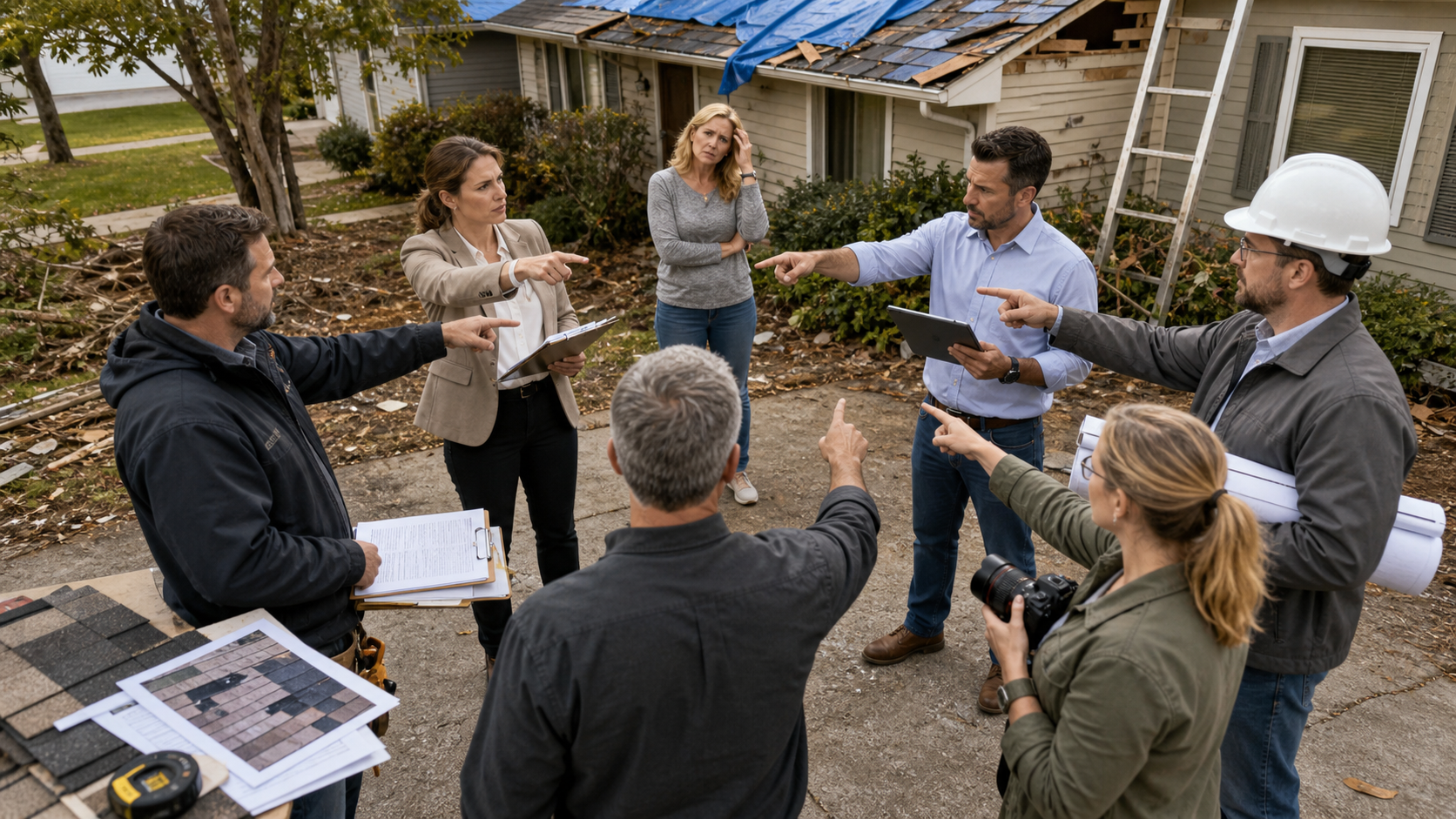
There are bad actors in every corner of the property insurance world.
Bad contractors exist. Bad public adjusters exist. Bad carrier adjusters exist. Bad engineers exist. Bad consultants exist on both sides of a claim.
That should not be controversial.
A contractor who inflates a scope, cuts corners, chases storms with no intention of doing quality work, or pressures a homeowner into signing something they do not understand is a problem. A public adjuster who overpromises, mishandles communication, or treats every claim like a guaranteed payday is a problem. An engineer who starts with the answer and works backward is a problem. A carrier adjuster who ignores damage, writes a thin estimate, or repeats company talking points instead of investigating the loss is a problem.
Bad conduct is unacceptable no matter whose shirt the person is wearing.
At Keathley Claims Consultants, we are not interested in pretending every contractor is right, every public adjuster is perfect, or every carrier employee is dishonest. That would be lazy, and it would not help homeowners.
But there is another truth that matters just as much:
When bad conduct becomes systemic inside the carrier claim process, the harm reaches a much broader group of people.
That is the difference.
A Bad Contractor Can Hurt a Homeowner
A bad contractor can absolutely damage a claim.
They may tell the homeowner everything is covered before reading the policy. They may use vague lump-sum pricing instead of a real estimate. They may fail to photograph damage before repairs begin. They may promise to “handle the insurance” without understanding where the line is between construction estimating and claim representation.
Some may inflate numbers just because insurance is involved. Some may push for replacement when a proper repair is realistic. Some may leave the homeowner with bad workmanship, missing documentation, or a supplement that never had a chance because the file was not built correctly.
That is real.
Homeowners should be careful about who they hire. Contractors should document the actual damage, write buildable repair scopes, communicate honestly, and stay in their lane. A contractor’s job is to identify and perform the repair work. If the claim needs representation, that is where a licensed public adjuster comes in.
A Bad Public Adjuster Can Hurt a Homeowner Too
Public adjusters are not magically immune from criticism.
A public adjuster should not take a claim they cannot help. They should not promise a specific outcome just to get a contract signed. They should not create conflict for the sake of fees. They should not ignore policy limits, exclusions, depreciation rules, documentation problems, or legitimate coverage issues.
The job is not to turn every claim into a fight.
The job is to represent the policyholder, document the loss, understand the policy, communicate the claim clearly, and push for the amount owed under the contract. If the claim is not there, the public adjuster should be honest about that.
Bad public adjusting damages the homeowner, the contractor relationship, and the credibility of the profession. It should be called out.
A Bad Engineer Can Tilt the Whole File
Engineers can be helpful when the issue is truly technical.
Was there structural movement? Did wind create the opening? Is cracking related to settlement, impact, deterioration, or a covered event? Is damage consistent with the date of loss? Those are fair questions.
But engineering opinions can also become a problem when the report reads like it was built to support a predetermined claim decision.
That can happen on either side. A report hired by a homeowner can overreach. A report hired by a carrier can minimize. The issue is not simply who paid the engineer. The issue is whether the opinion is supported by the site conditions, photos, testing, code, product behavior, weather data, and common sense.
Homeowners should read engineer reports carefully. Look for assumptions. Look for missing areas. Look for whether the engineer actually addressed the damage being claimed. A technical report should explain the evidence, not bury the homeowner under credentials and conclusions.
Carrier Adjusters Are Not the Enemy
Plenty of carrier adjusters are decent people doing a hard job.
Some are overloaded. Some are new. Some are dealing with desk reviews, photo estimates, vendor guidelines, software rules, supervisor approvals, and claim volume that makes real investigation harder than it should be.
The problem is not that every carrier adjuster is a bad person.
The problem is the system they work inside.
When a company handles millions of claims, even small claim-handling habits can create enormous financial consequences. A missed line item here. A repair-only scope there. A depreciation decision. A matching issue brushed aside. A code item ignored. A delay that wears down the policyholder. A vendor report treated as final even when the real-world repair does not match the report.
On one claim, that might look like a mistake.
Across thousands or millions of claims, the pattern matters.
The Carrier Side Has a Different Scale Problem
This is where the conversation has to be honest.
A bad contractor may hurt one homeowner at a time. A bad public adjuster may hurt one claim at a time. A bad engineer report may distort one file at a time.
But a carrier claim process built around consistently reducing claim severity can affect huge numbers of policyholders.
That does not require every adjuster to be malicious. It does not require a dramatic conspiracy. It can happen through ordinary systems:
- Estimating guidelines that leave out common repair items
- Software pricing treated as more real than local market conditions
- Repair scopes written even when replacement is the buildable solution
- Matching issues minimized as cosmetic complaints
- Depreciation applied aggressively
- Code items ignored until a contractor forces the issue
- Desk reviews used where field investigation is needed
- Preferred vendor opinions treated as neutral
- Claim delays that make homeowners tired enough to accept less
- Denial or limitation letters that sound final even when the facts are thin
That is why carrier-side underpayment matters so much. It happens inside a contract of indemnity. The homeowner paid premiums for protection. When a covered loss occurs, the purpose of the policy is to put the insured back in the position the contract requires, subject to the policy terms, limits, deductibles, and exclusions.
If the claim process routinely pays less than the real amount owed, that is not just a private disagreement. It is a widespread consumer problem.
The Float Incentive Matters
There is also a money reality most homeowners never think about.
Insurance companies do not just collect premiums and wait to pay claims. They hold large pools of money, invest that money, manage reserves, and measure claim severity across huge books of business. The longer money stays under the carrier’s control, and the lower the ultimate claim payment is, the better that can look inside the business.
Warren Buffett has explained this better than almost anyone because insurance float has been central to Berkshire Hathaway’s growth for decades. In Berkshire’s 2018 shareholder letter, Buffett described the property and casualty insurance model plainly: insurers receive premiums upfront and pay claims later. That collect-now, pay-later structure leaves insurers holding float, and, as Buffett wrote, insurers invest that float “for their own benefit.”
In Berkshire’s 2017 shareholder letter, Buffett described float as money that belonged to others but was held by Berkshire’s insurers. He also explained why that matters: when those funds are invested, the dividends, interest, and gains belong to Berkshire. In the 2024 letter, he noted that Berkshire’s insurance float had grown from $46 billion to $171 billion over two decades.
That is not a fringe theory. That is one of the most famous insurance investors in American business explaining how valuable float can be.
That does not mean every delayed claim is intentional. It does not mean every adjuster is thinking about investment income when they write an estimate. Most front-line adjusters are probably thinking about their workload, guidelines, supervisor approvals, and closing files.
But at the company level, the incentives matter.
If a carrier can hold money longer, reduce average claim payments, push policyholders toward smaller repairs, or make the supplement process exhausting enough that people give up, the financial benefit does not happen one claim at a time. It compounds across thousands of files.
That is why underpayment is not just frustrating. It is structural.
A homeowner waiting on $18,000 to repair a roof may feel like one person stuck in a slow claim. To the carrier, that file is part of a massive system of reserves, payments, cycle times, vendor programs, severity targets, and investment float.
That imbalance is the problem.
Indemnity Is Not a Favor
Insurance is not charity.
The carrier is not doing the homeowner a favor by paying a covered claim. The homeowner paid for a contract. That contract comes with duties on both sides.
The policyholder has duties too. They must report the claim, protect the property from further damage, cooperate, provide documentation, and avoid misrepresentation. That matters. A homeowner cannot ignore their obligations and then blame everyone else when the claim falls apart.
But the carrier also has duties. In Ohio, property and casualty claim handling is subject to minimum standards under Ohio Administrative Code 3901-1-54. That rule does not make every disputed claim automatically payable, and it is not a magic wand. But it does recognize that claim investigation, communication, and disposition have standards because the process matters.
The point is simple: a claim should be investigated and paid according to the policy and the facts, not according to the cheapest version of the loss.
”Bad on Every Side” Should Not Become an Excuse
One thing homeowners should watch for is false balance.
Yes, bad contractors exist.
Yes, bad public adjusters exist.
Yes, bad engineers exist.
Yes, some claims are exaggerated, poorly documented, or not covered.
But none of that excuses a carrier estimate that ignores real damage. It does not excuse a rushed inspection. It does not excuse a report that fails to address the actual condition of the property. It does not excuse paying for a patch when the repair will not restore the home. It does not excuse treating the policyholder like they are asking for something extra when they are asking for the benefit of the bargain.
Accountability has to run in every direction.
If the contractor is wrong, say so.
If the public adjuster is wrong, say so.
If the engineer is wrong, say so.
If the carrier’s estimate is wrong, say so.
The homeowner is the one stuck in the middle. They are the one living under the damaged roof, dealing with the wet drywall, trying to rebuild after a fire, waiting on payment, and trying to understand a policy they may have never read until the worst week of their life.
They deserve better than industry finger-pointing.
What Homeowners Should Do
If you are dealing with a property damage claim, do not assume the loudest person is right.
Slow the file down long enough to gather facts.
Start with the basics:
- Get the full carrier estimate, not just the check or payment letter
- Request the photos, reports, and written explanation behind the decision
- Take your own photos and video before repairs begin
- Keep damaged materials when possible
- Ask contractors for detailed, line-item scopes
- Save invoices, receipts, mitigation records, and communication
- Read the policy sections being cited
- Be cautious with anyone who guarantees an outcome
- Get a second claim review before accepting a low, confusing, or incomplete estimate
The goal is not to pick a side blindly. The goal is to find the truth of the loss and document it well enough that the claim can be handled correctly.
Where KCC Stands
Keathley Claims Consultants represents policyholders. That is our side.
But representing homeowners does not mean pretending everyone else is automatically wrong. It means looking at the damage, the policy, the estimate, the reports, the repair conditions, and the claim history. It means separating real issues from noise. It means pushing back when the carrier underpays, but also being honest when the facts do not support a fight.
There is bad conduct on every side of the industry.
The reason carrier-side underpayment deserves so much attention is because of scale, leverage, and the contract involved. A homeowner usually files only a few serious property claims in a lifetime. A carrier handles claims every day. The carrier has the adjusters, software, vendors, guidelines, lawyers, and payment authority.
That imbalance is exactly why policyholders need someone on their side.
If your Ohio insurance claim feels like it was handled through a system designed to pay less than the real damage, have KCC review it before you accept the estimate as final. We will tell you what is missing, what is documented, what needs more support, and whether the claim is worth fighting.
Bad on any side is unacceptable.
So is a system that makes underpayment feel normal.
Keathley Claims Consultants
Ohio Public Adjuster License #1367111
Serving homeowners across Ohio
(419) 504-1601
Sources Referenced
Tags